
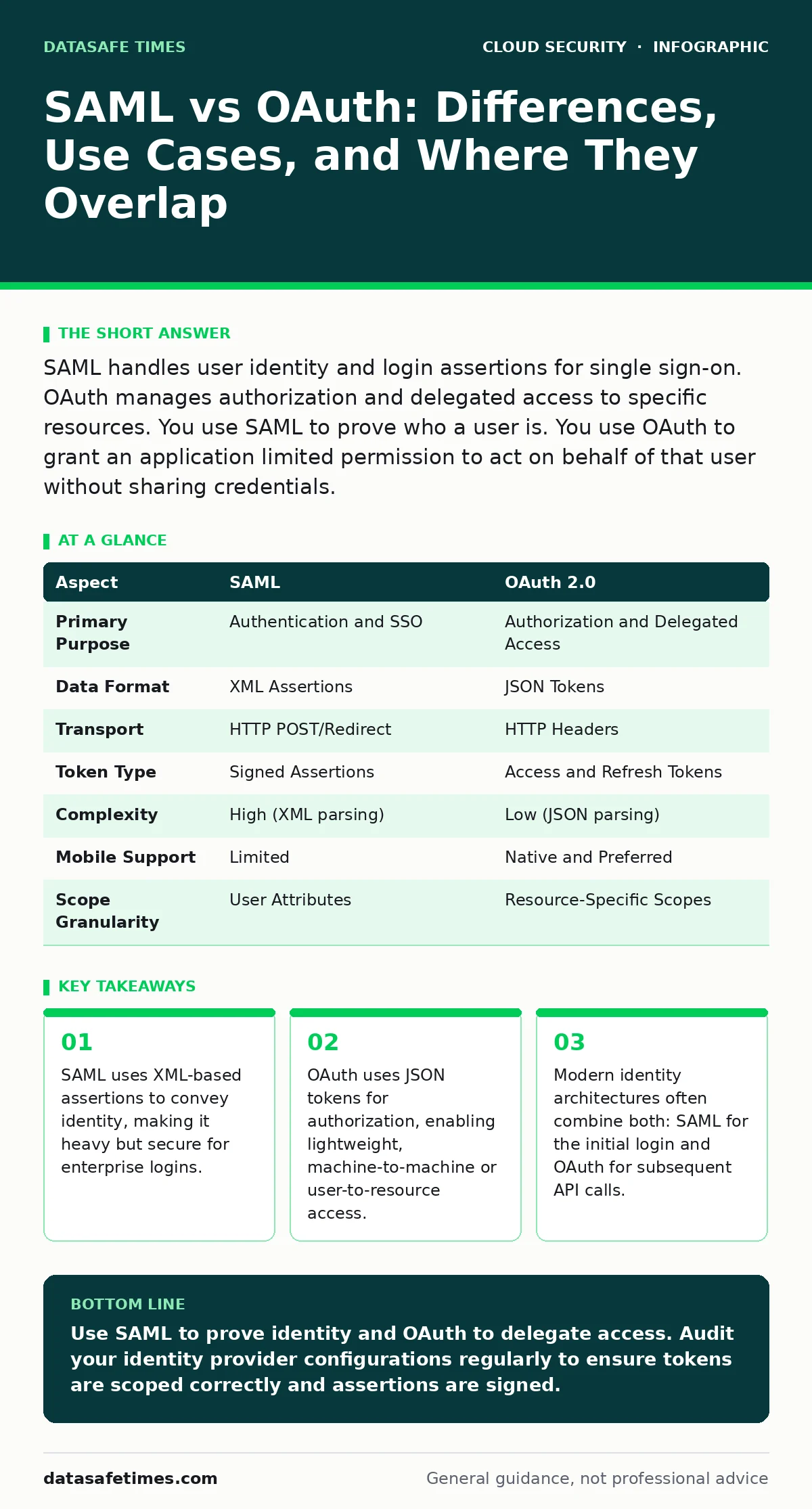
SAML handles user identity and login assertions for single sign-on. OAuth manages authorization and delegated access to specific resources. You use SAML to prove who a user is. You use OAuth to grant an application limited permission to act on behalf of that user without sharing credentials.
The Core Distinction Between Identity and Access
SAML (Security Assertion Markup Language) and OAuth (Open Authorization) solve different problems, despite frequent confusion in cloud security discussions. SAML answers the question of who you are. It establishes a trusted session after authentication. OAuth answers the question of what you are allowed to do. It grants limited access to specific resources without revealing your primary credentials.
Imagine a corporate network where employees need to access internal tools. SAML provides the digital keycard that proves their identity to the identity provider. OAuth provides the temporary pass that allows a specific application to read their calendar data. You cannot replace one with the other because they operate at different layers of the security stack. One validates the subject. The other validates the permission.
What SAML Actually Does
SAML is an XML-based standard for exchanging authentication and authorization data between parties. Specifically, it allows an identity provider (IdP) to pass user authentication status to a service provider (SP). When you log in to a corporate portal, the IdP creates a signed XML document called an assertion. This assertion contains attributes about the user, such as their role or group membership.
The service provider trusts the IdP’s signature. It reads the assertion and creates a local session. The user never shares their password with the service provider. This mechanism supports single sign-on (SSO) across multiple applications. The heavy XML payload ensures rich attribute transfer, which is useful for complex enterprise environments. It also enforces strict cryptographic verification at every step.
What OAuth Actually Does
OAuth 2.0 is a framework for authorization, not authentication. It allows a third-party application to obtain limited access to a user’s resources on an HTTP service. The protocol issues access tokens instead of credentials. These tokens define the scope of access, such as reading emails but not sending them.
The flow involves the user granting permission to the client application. The authorization server then issues a token to the client. The client presents this token to the resource server to access data. If the token expires or is revoked, access stops immediately. This model prevents credential stuffing and reduces the blast radius of a compromised application. It does not, however, tell the resource server who the user is unless you extend the protocol.
Point-by-Point Comparison
The structural differences dictate where each protocol belongs. SAML is stateful and heavy. OAuth is stateless and light.
| Aspect | SAML | OAuth 2.0 |
|---|---|---|
| Primary Purpose | Authentication and SSO | Authorization and Delegated Access |
| Data Format | XML Assertions | JSON Tokens |
| Transport | HTTP POST/Redirect | HTTP Headers |
| Token Type | Signed Assertions | Access and Refresh Tokens |
| Complexity | High (XML parsing) | Low (JSON parsing) |
| Mobile Support | Limited | Native and Preferred |
| Scope Granularity | User Attributes | Resource-Specific Scopes |
Where The Protocols Overlap
Modern identity platforms often bundle SAML and OAuth to provide a complete solution. This overlap creates confusion because the same login screen might use both protocols behind the scenes. The initial login often uses SAML to establish the user’s identity. Subsequent API calls use OAuth tokens to access specific resources.
This hybrid approach leverages the strengths of both. SAML provides the robust identity assertion needed for compliance and audit trails. OAuth provides the flexible, granular access control needed for modern applications. Developers must understand that the session established by SAML does not automatically grant OAuth permissions. The user must still grant consent for each OAuth scope.
See also: Immutable Infrastructure: Definition, Mechanics, and Common Pitfalls · Cloud Attack Surface Explained: Mapping Your Hidden Exposure
Choose SAML When
Select SAML for scenarios requiring strict identity verification and rich attribute transfer. Enterprise single sign-on remains the primary use case. SAML excels when you need to pass multiple user attributes, such as department, cost center, or security clearance, to the service provider.
SAML is also preferred in regulated industries that require detailed audit logs of identity assertions. The XML format allows for complex claims that JSON tokens in OAuth cannot easily replicate. If your infrastructure relies on legacy systems that do not support modern token standards, SAML provides a stable, well-documented integration path. It forces the service provider to trust the identity provider completely, which simplifies the trust model.
Choose OAuth When
Select OAuth for applications that need to access user data without storing credentials. This is the standard for social logins, mobile applications, and API integrations. OAuth allows a third-party app to read your data while keeping your password private.
OAuth is superior for machine-to-machine communication when combined with client credentials flows. It supports fine-grained scopes, allowing you to grant read-only access to a specific folder rather than full account access. The lightweight JSON format is easier to parse on mobile devices and embedded systems. Revocation is immediate and granular, reducing risk if a token is intercepted.
Integrating With Cloud Security Controls
Understanding these protocols is critical for effective cloud security posture management (CSPM). Misconfigured identity providers often lead to exposure. You must review cloud audit logs to ensure that SAML assertions are signed and OAuth tokens are short-lived.
Cloud logging gaps can hide unauthorized access if the identity provider does not emit detailed events. Ensure your virtual private clouds restrict direct access to identity endpoints. The shared responsibility model places the burden of identity configuration on you, not the cloud provider. Properly configured Kubernetes network policies can limit which services can communicate with the identity provider.
Key takeaways
- SAML uses XML-based assertions to convey identity, making it heavy but secure for enterprise logins.
- OAuth uses JSON tokens for authorization, enabling lightweight, machine-to-machine or user-to-resource access.
- Modern identity architectures often combine both: SAML for the initial login and OAuth for subsequent API calls.
Use SAML to prove identity and OAuth to delegate access. Audit your identity provider configurations regularly to ensure tokens are scoped correctly and assertions are signed.
Frequently asked questions
Can OAuth be used for authentication?
OAuth 2.0 is strictly for authorization. However, OpenID Connect (OIDC) is an identity layer built on top of OAuth 2.0 that adds authentication capabilities through ID tokens.
Is SAML secure enough for modern applications?
SAML is secure when configured correctly. The XML signature prevents tampering. However, the complexity of XML can lead to implementation errors that attackers exploit.
Do I need both SAML and OAuth in my cloud architecture?
Most enterprise architectures use both. SAML handles the initial user login and SSO. OAuth handles subsequent API access and delegated permissions for applications.
How do cloud attack surface maps relate to SAML?
Identity endpoints are part of the cloud attack surface. Misconfigured SAML trusts can allow attackers to inject false assertions, bypassing authentication entirely.
How this guide was produced: written by the DataSafe Times editorial team with AI assistance, checked against the public references listed below, and reviewed when the facts change. See our editorial policy or report an error.