
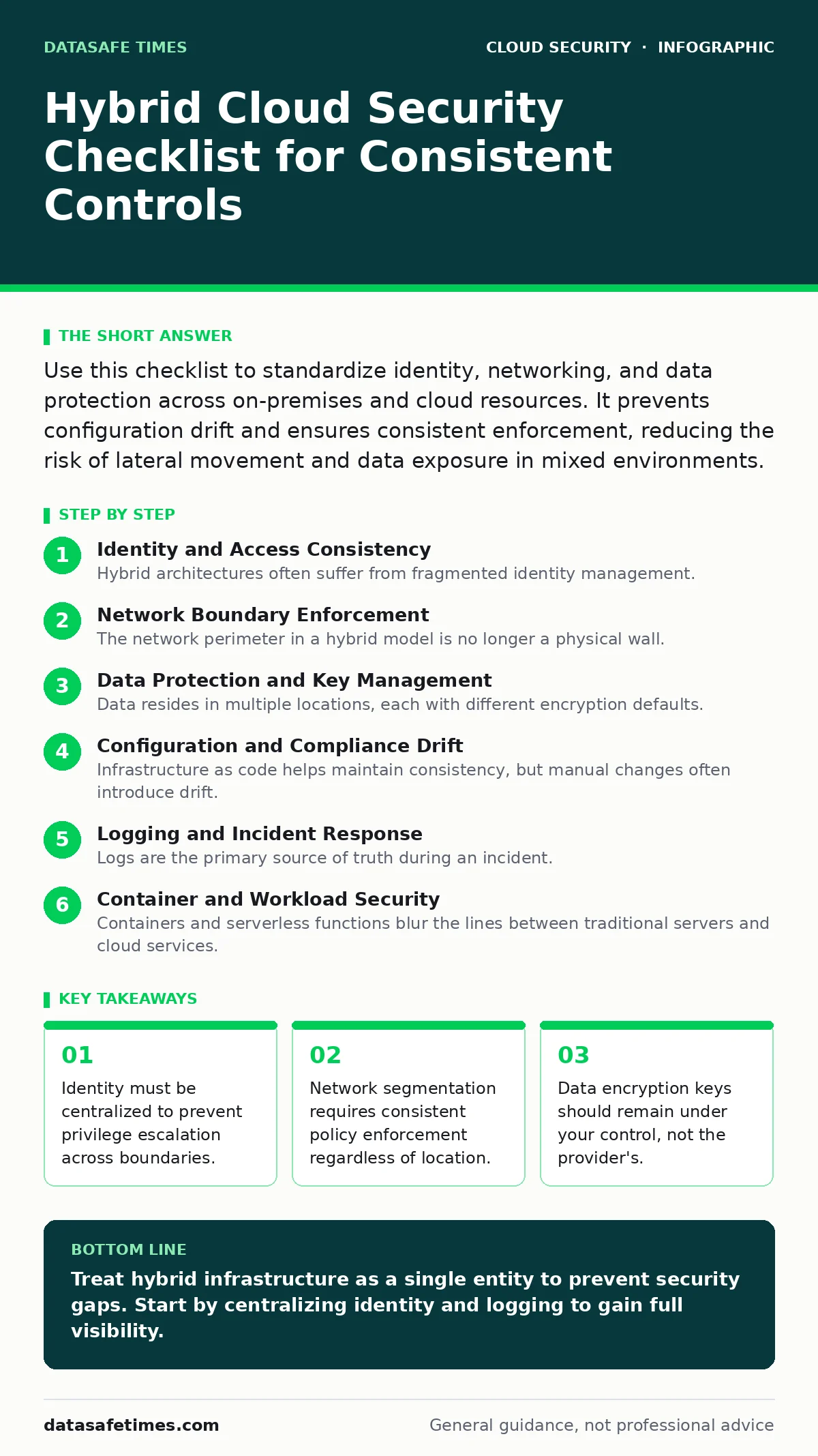
Use this checklist to standardize identity, networking, and data protection across on-premises and cloud resources. It prevents configuration drift and ensures consistent enforcement, reducing the risk of lateral movement and data exposure in mixed environments.
Identity and Access Consistency
Hybrid architectures often suffer from fragmented identity management. When on-premises directories and cloud identities operate in silos, attackers exploit the gaps between them. You must unify authentication sources to ensure that a user’s permissions are consistent everywhere.
- Connect on-premises directory services to cloud identity providers: This prevents duplicate accounts and ensures that disabling a user locally also revokes cloud access.
- Enforce MFA for cloud accounts globally: Multi-factor authentication adds a layer of verification that protects against stolen credentials, which is a primary vector for initial compromise.
- Audit privileged access quarterly: Regular reviews of high-privilege accounts reduce the risk of dormant credentials being used for lateral movement.
Network Boundary Enforcement
The network perimeter in a hybrid model is no longer a physical wall. It is a set of policies applied to traffic flowing between data centers and cloud regions. Inconsistent firewall rules or misconfigured virtual networks create blind spots where malicious traffic can hide.
- Implement zero-trust network segmentation: Zero-trust assumes no traffic is safe by default, requiring verification for every connection request regardless of its origin.
- Standardize firewall rules across environments: Consistent rule sets prevent attackers from finding weaker defenses in one segment to pivot into another.
- Monitor cross-premises traffic flows: Visibility into data moving between on-premises servers and cloud instances helps detect exfiltration or command-and-control activity.
Suppose an attacker compromises a server in your data center. If network policies are loose, they can move laterally to cloud storage buckets. Tight segmentation limits this blast radius.
Data Protection and Key Management
Data resides in multiple locations, each with different encryption defaults. Relying on provider-managed encryption keys can create compliance issues and reduce your control over data access. You must manage encryption keys to maintain sovereignty over your information.
- Use customer-managed encryption keys: Managing your own keys ensures that only you can decrypt data, even if the cloud provider is compromised or compelled to hand over data.
- Encrypt data in transit and at rest: Encryption protects data from interception during transfer and from unauthorized access when stored on disks.
- Integrate secrets managers for application credentials: Secrets managers store sensitive information like API keys and database passwords securely, preventing hardcoding in source code.
Configuration and Compliance Drift
Infrastructure as code helps maintain consistency, but manual changes often introduce drift. When on-premises and cloud configurations diverge, security controls become unpredictable. Automated scanning ensures that your environment matches your security baseline.
- Scan for configuration misconfigurations regularly: Automated tools identify deviations from secure baselines, such as open storage buckets or overly permissive security groups.
- Align policies with the shared responsibility model: Understanding which security tasks fall to you and which fall to the provider prevents gaps in coverage.
- Automate remediation for critical findings: Automatic fixes reduce the window of exposure for high-risk misconfigurations that manual processes might miss.
Review your cloud vulnerability management processes to ensure that software dependencies are patched consistently across all environments.
Logging and Incident Response
Logs are the primary source of truth during an incident. In hybrid environments, logs are scattered across different platforms, making correlation difficult. Centralizing log collection enables faster detection and response to threats.
- Centralize cloud audit logs: Aggregating logs from all cloud services and on-premises systems into a single repository allows for comprehensive analysis and correlation.
- Define alert thresholds for anomalous activity: Setting specific thresholds for unusual login patterns or data transfers helps identify potential breaches early.
- Test incident response plans annually: Regular testing ensures that your team knows how to respond to incidents that span both on-premises and cloud environments.
Imagine a ransomware attack that starts in the cloud and spreads to your data center. Without centralized logging, you may not see the full scope of the infection until it is too late.
See also: Cloud Attack Surface Explained: Mapping Your Hidden Exposure · Cloud Security Posture Management: 6 Common Misunderstandings
Container and Workload Security
Containers and serverless functions blur the lines between traditional servers and cloud services. They move quickly and often bypass traditional security controls. You must apply security policies that follow the workload, not the underlying infrastructure.
- Apply Kubernetes network policies: Network policies control traffic flow between pods, preventing unauthorized access within the cluster.
- Scan container images for vulnerabilities: Scanning before deployment ensures that known security flaws are not introduced into your environment.
- Restrict container privileges: Running containers with minimal privileges reduces the impact of a compromise, limiting what an attacker can do.
Final Verification Steps
Before deploying new hybrid resources, verify that all controls are in place. This final check ensures that security is not an afterthought.
- Verify access key rotation policies: Regularly rotating access keys limits the damage if a key is compromised.
- Confirm data backup and recovery procedures: Reliable backups ensure that you can restore data in the event of ransomware or accidental deletion.
- Validate disaster recovery plans: Testing recovery procedures ensures that you can restore operations quickly after a significant outage.
Key takeaways
- Identity must be centralized to prevent privilege escalation across boundaries.
- Network segmentation requires consistent policy enforcement regardless of location.
- Data encryption keys should remain under your control, not the provider's.
Treat hybrid infrastructure as a single entity to prevent security gaps. Start by centralizing identity and logging to gain full visibility.
Frequently asked questions
How often should I rotate access keys?
Rotate access keys regularly, ideally every few months, or immediately if a compromise is suspected.
What is the shared responsibility model?
It defines which security tasks are handled by the cloud provider and which are the customer's responsibility, ensuring no gaps in coverage.
Can I use the same firewall rules for on-premises and cloud?
Yes, standardizing rules helps maintain consistency and reduces the risk of misconfiguration across different environments.
Why is centralizing logs important?
Centralizing logs allows you to correlate events across different systems, making it easier to detect and respond to complex threats.
How this guide was produced: written by the DataSafe Times editorial team with AI assistance, checked against the public references listed below, and reviewed when the facts change. See our editorial policy or report an error.