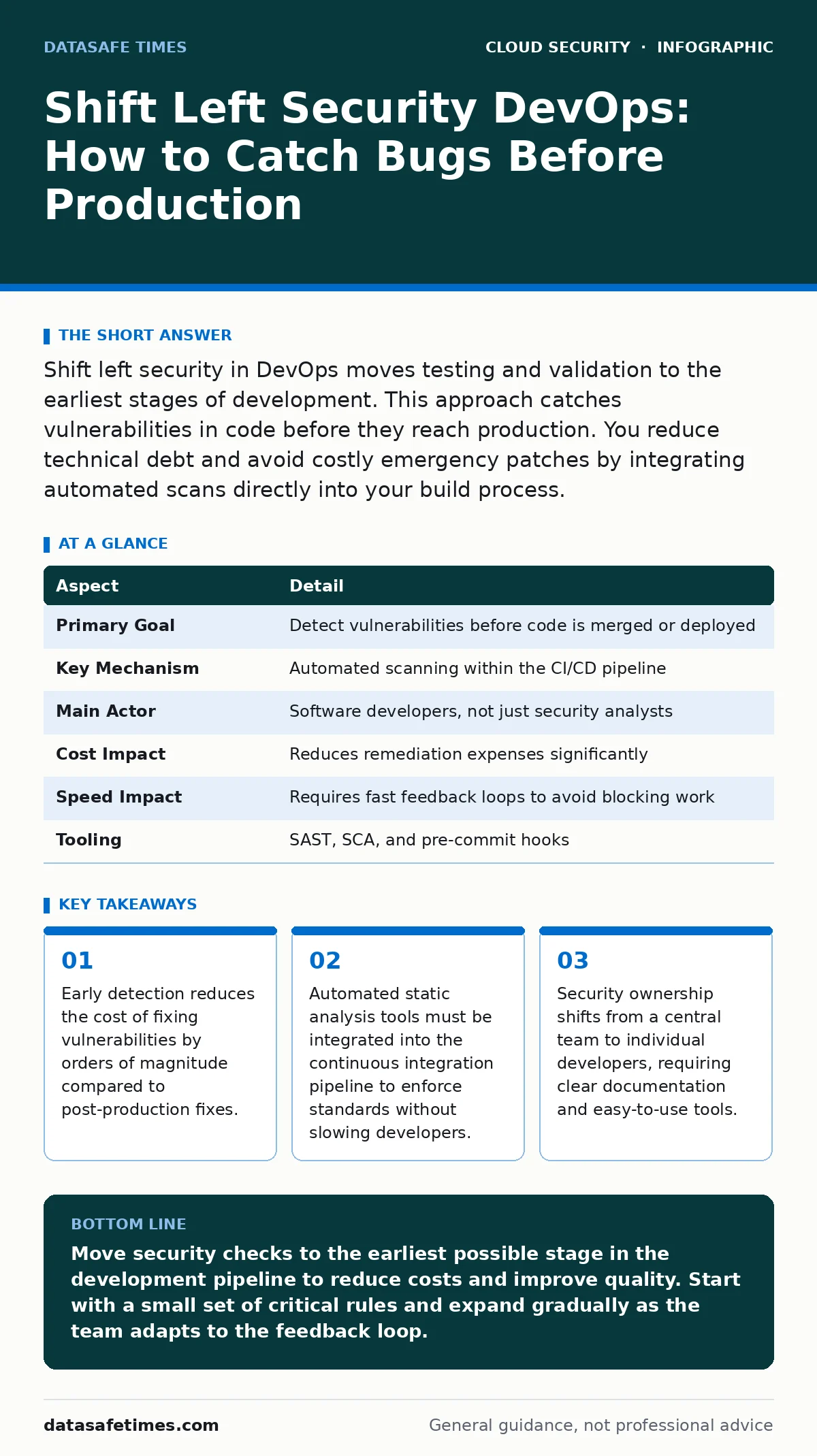
Shift left security in DevOps moves testing and validation to the earliest stages of development. This approach catches vulnerabilities in code before they reach production. You reduce technical debt and avoid costly emergency patches by integrating automated scans directly into your build process.
Everyday Analogy for Early Detection
Imagine constructing a house. Finding a crack in the foundation after the roof is installed requires tearing down the entire structure. Finding that same crack during the initial pour allows for a simple patch. Shift left security applies this logic to software. It moves security validation from the final inspection phase to the initial design and coding phases. This prevents structural flaws from becoming permanent features of the application.
At a Glance: The Shift Left Model
| Aspect | Detail |
|---|---|
| Primary Goal | Detect vulnerabilities before code is merged or deployed |
| Key Mechanism | Automated scanning within the CI/CD pipeline |
| Main Actor | Software developers, not just security analysts |
| Cost Impact | Reduces remediation expenses significantly |
| Speed Impact | Requires fast feedback loops to avoid blocking work |
| Tooling | SAST, SCA, and pre-commit hooks |
What Is Shift Left Security DevOps
Shift left security devOps is the practice of integrating security controls into the early stages of the software development lifecycle. The term "shift left" refers to moving activities from the right side of the timeline (production) to the left side (development). In traditional models, security teams test applications after development is complete. This creates a bottleneck and delays release. In a shifted model, developers run security checks as they write code. This integration ensures that security constraints are visible and actionable during the creative process.
How It Works in Practice
The mechanism relies on automation and immediate feedback. Developers install pre-commit hooks that run static analysis on code before it is saved to the repository. The continuous integration server runs deeper scans on every pull request. If a vulnerability is detected, the build fails. The developer receives a specific error message pointing to the exact line of code. This loop must be fast. If the scan takes hours, developers will bypass it. The system must provide clear remediation advice. Vague warnings cause alert fatigue and are ignored.
Who It Affects in the Organization
This model changes responsibilities across the engineering team. Developers become the first line of defense. They must understand basic security principles and how to read scan results. Security engineers shift from manual testers to tool builders. They configure the scanners and tune rules to reduce false positives. Product managers must account for security time in sprint planning. Ignoring this time leads to rushed releases and skipped checks. The cultural shift is as significant as the technical one. Trust replaces gatekeeping.
See also: Cloud Attack Surface Explained: Mapping Your Hidden Exposure · SAML vs OAuth: Differences, Use Cases, and Where They Overlap
Common Misunderstandings About Early Security
Many organizations believe shift left means replacing security teams with tools. This is incorrect. Tools require configuration and context. False positives erode trust in the system. Another mistake is treating security as a single step. Security is a continuous set of checks. Some teams implement heavy scanning that slows down development. This creates resistance. The goal is frictionless security, not maximum security. You must balance thoroughness with speed. Also, people often ignore cloud security posture management (CSPM) in favor of code scanning. Infrastructure misconfigurations are just as dangerous as code bugs.
What To Do About Implementation
Start with a small set of high-impact rules. Do not enable every rule in a scanner. This creates noise. Focus on critical vulnerabilities like injection flaws or hardcoded secrets. Integrate these checks into the existing build pipeline. Ensure the feedback is visible in the developer's interface. Provide clear documentation on how to fix common issues. Train developers on reading security reports. Gradually expand the rule set as the team adapts. Measure the time to remediate. If it increases, you are adding too much friction. Review and adjust the rules regularly.
Integrating With Related Practices
Shift left security works best when combined with other controls. For instance, MFA for cloud accounts prevents credential theft even if code is secure. Immutable infrastructure ensures that once code is deployed, it cannot be altered, reducing runtime risks. You should also consider Kubernetes network policies to limit lateral movement if a container is compromised. These measures complement early code scanning. They address different layers of the stack. A holistic approach covers code, configuration, and access.
Balancing Speed and Safety
The trade-off is between velocity and assurance. Tighter checks slow down releases. Looser checks risk vulnerabilities. You must find the equilibrium. Use risk-based prioritization. Not all code requires the same level of scrutiny. Public-facing APIs need stricter checks than internal tools. Automate the mundane checks. Reserve manual review for complex logic. This keeps the pipeline moving while maintaining high standards. Regularly review the effectiveness of your tools. Remove rules that generate no value.
Final Thoughts On Adoption
Adoption takes time. Do not expect immediate perfection. Start with visibility. Show developers where the risks are. Then move to enforcement. Build trust by providing useful feedback. Involve security in design discussions. This prevents architectural flaws that are hard to fix later. Remember that cloud identity governance is also part of the left shift. Permissions defined early reduce privilege escalation risks. Security is a habit, not a destination.
Key takeaways
- Early detection reduces the cost of fixing vulnerabilities by orders of magnitude compared to post-production fixes.
- Automated static analysis tools must be integrated into the continuous integration pipeline to enforce standards without slowing developers.
- Security ownership shifts from a central team to individual developers, requiring clear documentation and easy-to-use tools.
Move security checks to the earliest possible stage in the development pipeline to reduce costs and improve quality. Start with a small set of critical rules and expand gradually as the team adapts to the feedback loop.
Frequently asked questions
Does shift left security replace the need for penetration testing?
No, it complements it. Early checks catch common coding errors. Penetration testing finds complex logical flaws and architectural weaknesses that automated tools miss.
How do we handle false positives in automated scans?
Tune the rules to match your codebase. Suppress known safe patterns. Provide clear context so developers can distinguish real risks from noise.
Can we implement shift left without changing our tools?
Yes, but it is harder. Many modern CI/CD platforms support plugin integration. You may need to configure existing scanners to run earlier in the process.
What is the biggest risk to this approach?
Alert fatigue. If developers receive too many irrelevant warnings, they will ignore them. Keep the signal-to-noise ratio high by focusing on actionable findings.
How this guide was produced: written by the DataSafe Times editorial team with AI assistance, checked against the public references listed below, and reviewed when the facts change. See our editorial policy or report an error.