
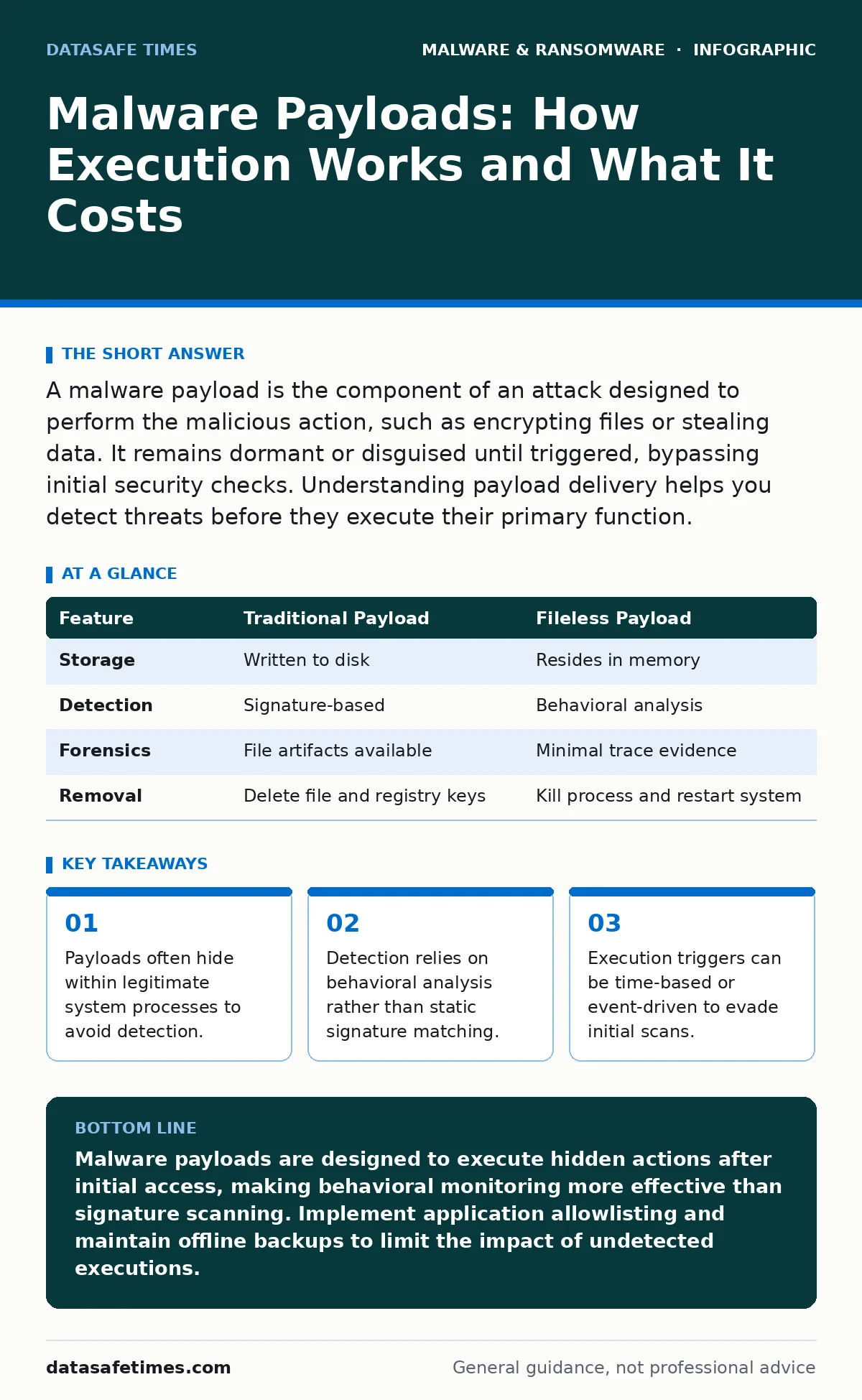
A malware payload is the component of an attack designed to perform the malicious action, such as encrypting files or stealing data. It remains dormant or disguised until triggered, bypassing initial security checks. Understanding payload delivery helps you detect threats before they execute their primary function.
What is a malware payload?
A malware payload is the specific code that performs the malicious action after a system is compromised. It is distinct from the delivery mechanism, which might be a phishing email or a drive-by download. The payload is what causes the actual harm, whether that is data theft, system disruption, or resource consumption.
How does a payload differ from a dropper?
A dropper is a program that installs malware onto a system, while the payload is the malware itself. Think of the dropper as the envelope and the payload as the letter inside. The dropper often contains code to bypass initial security checks, allowing the payload to land quietly. Once installed, the dropper may delete itself to remove traces of the delivery method.
Why do some payloads remain dormant for weeks?
Delaying execution allows attackers to avoid initial detection by security tools that scan for active threats. This technique, known as persistence, lets the malware blend in with normal system activity. Attackers often set triggers based on specific times, user actions, or network conditions. This waiting period gives the attacker time to establish a foothold before launching the main attack.
How do payloads evade antivirus software?
Modern payloads use obfuscation to hide their true code from static analysis tools. Obfuscation scrambles the code structure without changing its function, making it difficult for signature-based scanners to recognize. They may also use packing, which compresses and encrypts the executable until runtime. By the time the code is unpacked and running, it may already have bypassed the initial security layer.
What are common triggers for payload execution?
Execution triggers can range from simple file drops to complex network conditions. Some payloads wait for a specific file to be created or deleted on the system. Others activate only when the system connects to a particular network or when a command from a remote server is received. This conditional execution makes it harder for automated systems to predict and block the attack.
See also: What Is Mobile Malware: How It Hides in Apps and Steals Data · Deploy Next-Generation Antivirus: A Practical Implementation Plan
How do fileless payloads operate without leaving files?
Fileless malware runs entirely in memory, avoiding the hard drive where traditional antivirus tools look for threats. It often uses legitimate system tools, such as PowerShell or Windows Management Instrumentation, to execute its code. Because no malicious file is written to disk, standard file-based detection methods fail. This approach leaves fewer forensic artifacts, making investigation more difficult.
| Feature | Traditional Payload | Fileless Payload |
|---|---|---|
| Storage | Written to disk | Resides in memory |
| Detection | Signature-based | Behavioral analysis |
| Forensics | File artifacts available | Minimal trace evidence |
| Removal | Delete file and registry keys | Kill process and restart system |
Can a payload change its behavior after installation?
Yes, many payloads are designed to adapt based on the environment they detect. They may check for virtual machines or sandboxed environments used by security researchers. If a sandbox is detected, the payload might remain dormant or perform a harmless action to appear benign. Once in a real production environment, it activates its full malicious capabilities. This polymorphic behavior complicates static analysis and testing.
How do you detect a payload that has no signature?
Detection requires shifting from looking for known bad files to looking for bad behavior. Endpoint detection and response (EDR) systems monitor system calls and network connections for anomalies. You should look for processes that should not be communicating with external servers or accessing sensitive data. Behavioral analysis identifies the action, regardless of the code’s appearance or name.
What is the role of encryption in ransomware payloads?
In ransomware, the payload’s primary function is to encrypt files using strong cryptographic algorithms. It often targets specific file types, such as documents and databases, while leaving system files untouched to avoid immediate detection. The encryption is typically asymmetric, meaning the attacker holds the private key needed to reverse the process. This makes recovery impossible without the key or a backup.
How do cryptojacking payloads consume resources?
Cryptojacking payloads mine cryptocurrency by using the victim’s CPU or GPU cycles. They often hide their activity by throttling resource usage to stay below detection thresholds. The goal is to remain undetected for as long as possible to maximize profit. This slow burn can degrade system performance over time, leading to user complaints without triggering immediate alerts.
Can a payload be removed without reinstalling the system?
In many cases, yes, if the payload does not deeply embed itself in the operating system core. Tools that scan for known malicious behaviors can identify and terminate the processes. However, if the payload has modified system files or installed rootkits, a clean reinstall is often the only secure option. Rootkits hide at the kernel level, making them nearly impossible to detect and remove with standard tools.
How does application allowlisting prevent payload execution?
Application allowlisting permits only pre-approved software to run, blocking anything else by default. This stops unauthorized payloads from executing, even if they bypass initial detection. It forces the attacker to find a vulnerability in an allowed application to run their code. This method is highly effective against unknown threats because it relies on identity, not reputation.
Why are offline backups critical against payloads?
Offline backups provide a clean copy of data that is not connected to the network. If a ransomware payload encrypts your live data, the offline backup remains untouched. This ensures you can restore files without paying a ransom or losing data permanently. Regular testing of these backups is necessary to ensure they are readable and complete.
How does business continuity planning address payload impacts?
Business continuity planning outlines the steps to maintain operations during and after a security incident. It defines roles, communication channels, and recovery procedures. Having a plan reduces the chaos that follows a payload execution, allowing for a faster response. It also helps manage the financial and reputational damage caused by downtime.
What is the connection between recovery time objective and payloads?
Recovery time objective is the maximum acceptable amount of time a system can be down. Payloads that cause widespread disruption, such as ransomware, directly impact this metric. Faster detection and response reduce the time needed to restore services. Organizations must balance security measures with the need for rapid recovery to meet their operational goals.
Key takeaways
- Payloads often hide within legitimate system processes to avoid detection.
- Detection relies on behavioral analysis rather than static signature matching.
- Execution triggers can be time-based or event-driven to evade initial scans.
Malware payloads are designed to execute hidden actions after initial access, making behavioral monitoring more effective than signature scanning. Implement application allowlisting and maintain offline backups to limit the impact of undetected executions.
Frequently asked questions
How do I know if a payload has executed on my system?
Look for unexpected processes, unusual network connections, or sudden changes in file permissions and timestamps.
Can firewalls stop malware payloads?
Firewalls block network traffic but cannot stop a payload that has already executed inside the network.
Is cloud storage safe from ransomware payloads?
Cloud storage is only safe if you have versioning enabled and the ransomware cannot access your credentials to delete or encrypt cloud files.
Do antivirus updates catch all new payloads?
No, new payloads often evade signature-based detection until a new signature is created and distributed.
How this guide was produced: written by the DataSafe Times editorial team with AI assistance, checked against the public references listed below, and reviewed when the facts change. See our editorial policy or report an error.