
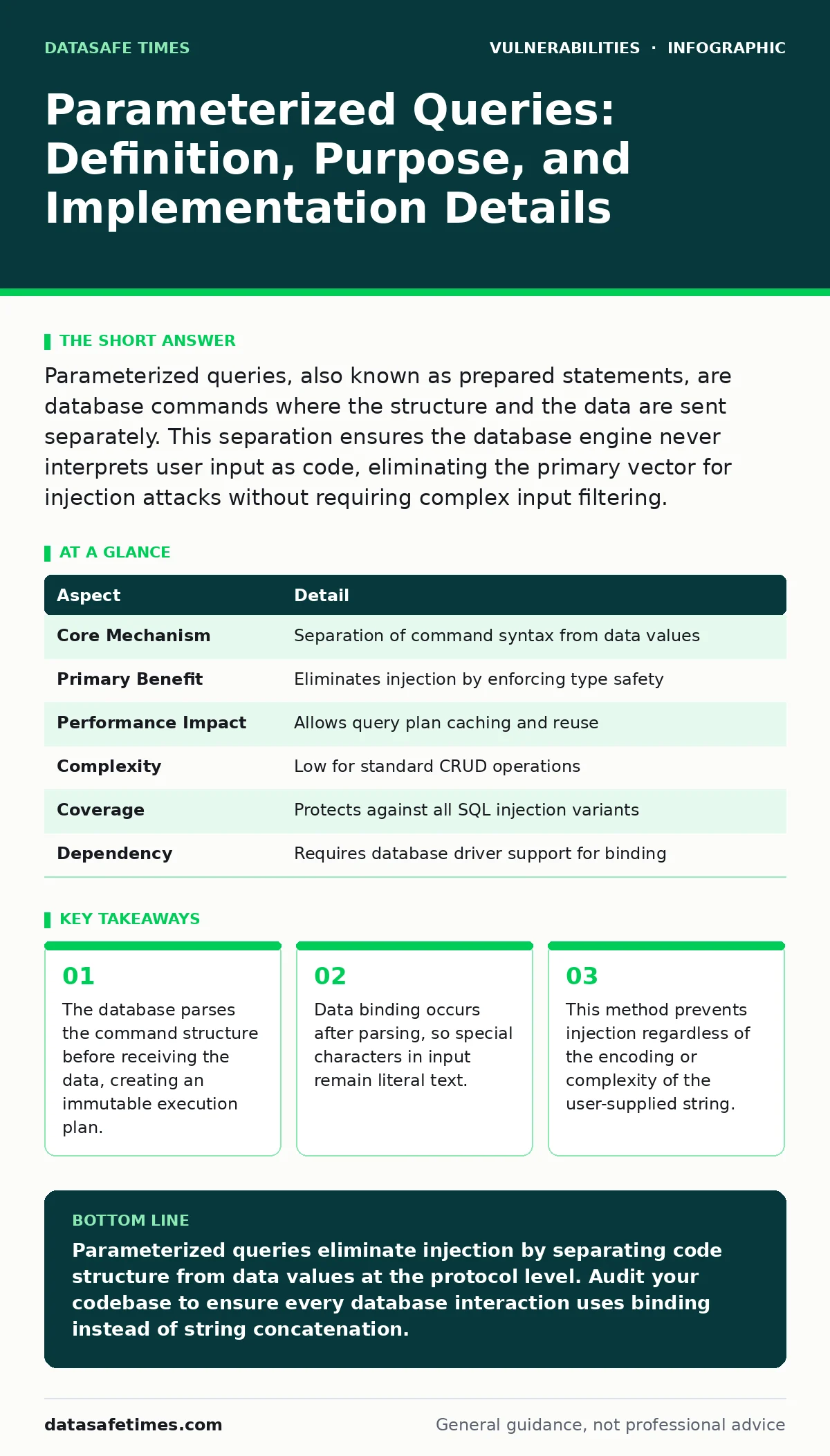
Parameterized queries, also known as prepared statements, are database commands where the structure and the data are sent separately. This separation ensures the database engine never interprets user input as code, eliminating the primary vector for injection attacks without requiring complex input filtering.
The Blueprint Analogy
Imagine you are handing a contractor a set of blueprints for a house. The blueprints define where the walls go, where the pipes run, and where the electrical outlets sit. You also provide a separate list of materials: specific brands of paint, types of lumber, and fixtures. The contractor builds exactly what the blueprints say using the materials you provided.
They do not read the paint can label and decide to add a secret room because the label says "Add Room Here." Parameterized queries work by separating the blueprint from the materials. The database engine receives the structure first, then the data. This separation ensures the structure remains unchanged regardless of what the data contains.
| Aspect | Detail |
|---|---|
| Core Mechanism | Separation of command syntax from data values |
| Primary Benefit | Eliminates injection by enforcing type safety |
| Performance Impact | Allows query plan caching and reuse |
| Complexity | Low for standard CRUD operations |
| Coverage | Protects against all SQL injection variants |
| Dependency | Requires database driver support for binding |
The Problem It Solves
Standard string concatenation builds a single text string containing both the command and the data. If a user inputs a value that includes special characters, the database parser cannot distinguish between the intended data and the command structure. This ambiguity allows an attacker to alter the logic of the query. They can bypass authentication, extract sensitive tables, or modify data.
The root cause is not malicious intent but the parser’s inability to know where the data ends and the code begins. When you concatenate strings, you hand the parser a ambiguous message. It guesses the structure based on delimiters. An attacker provides input that tricks the parser into guessing incorrectly. This is the definition of an injection vulnerability.
Main Parts of the Mechanism
A parameterized query consists of 3 distinct components. First, the template defines the command structure with placeholders. These placeholders mark where data will be inserted. Second, the data values are prepared separately. They are not part of the template string. Third, the binding step connects the values to the placeholders. The database driver sends the template to the server for parsing.
The server creates an execution plan. Then the driver sends the data values. The server binds the values to the plan. Because the plan is already fixed, the values cannot change the structure. This is 2 checks: parsing happens before data arrival, and binding happens after parsing. The order is critical. If data arrives before parsing, the protection fails.
Where It Fits in Defense
Defense in depth requires multiple layers. Parameterized queries are the primary control for database interactions. They sit below input validation. Input validation checks for format and range. It rejects obviously invalid data. However, validation rules are often incomplete. New encoding schemes bypass static rules. Parameterized queries do not care about encoding. They care about structure. This layer also sits above access controls.
Access controls limit what a user can do. If an injection occurs, access controls might stop the worst outcomes. But they do not prevent the attack. You need both. Parameterized queries prevent the attack. Access controls limit the damage. Using memory-safe programming languages can also reduce the risk of buffer overflows that might leak query strings, but they do not fix the logic error in the query construction itself.
Common Misconceptions
Developers often believe that escaping special characters is equivalent to parameterization. It is not. Escaping relies on knowing every special character and every encoding context. Context changes frequently. A value safe for a string literal might be dangerous in a numeric context. Parameterization removes the context problem. Another misconception is that stored procedures provide automatic protection. They do not.
Stored procedures are just functions. If you build the procedure call using string concatenation, you can still inject. The protection comes from how you call the procedure, not the procedure itself. Some teams think that using an ORM (Object-Relational Mapper) guarantees safety. Most ORMs use parameterized queries by default. But many allow raw SQL execution. If you fall back to raw SQL, you lose the protection. You must verify the ORM configuration.
See also: Path Traversal Vulnerabilities: Step-by-Step Breakdown · Fuzz Testing Meaning: How Random Inputs Break Your Code
Edge Cases and Limitations
Parameterized queries have limits. You cannot parameterize identifiers. Table names, column names, and sorting directions must be hardcoded or validated. You cannot use a placeholder for a column name. The database engine needs to know the schema before binding values. This creates a trade-off. Dynamic queries require careful validation. You must maintain a whitelist of allowed identifiers. Another limit is performance in high-churn environments.
If every query is unique, the benefit of query plan caching diminishes. The overhead of preparing and binding values adds latency. For simple, static queries, the difference is negligible. For complex, dynamic reports, the overhead might be measurable. However, the security benefit usually outweighs the cost. You should also consider path traversal vulnerabilities when handling file uploads that might be linked to database records. The database protection does not stop an attacker from manipulating file paths.
Integration with Other Controls
Security is not a single tool. It is a system. Parameterized queries work best with other measures. You should combine them with least privilege accounts. The database user should only have permissions needed for the application. If an injection occurs, the attacker has limited access. You should also log all database errors. Logs help you detect attempts. They do not prevent them, but they provide visibility. Regular fuzz testing can help identify inputs that break your parsing logic.
While fuzzing is often used for binary inputs, it can also reveal edge cases in query construction. Additionally, keeping your database software updated is necessary. Firmware vulnerabilities in the database engine itself could bypass application-level protections. You cannot patch the database engine with code. You must apply vendor updates. This is similar to Patch Tuesday updates for operating systems. You must have a process for applying these updates quickly.
Implementation Checklist
Use this list to verify your implementation. Each item requires a specific action.
- Replace all string concatenation in database calls with parameter binding.
- Identify all dynamic identifiers (tables, columns) and implement whitelist validation.
- Verify that the database driver supports prepared statements for your query types.
- Test with special characters and multi-byte encodings to ensure binding works.
- Review ORM settings to disable raw SQL execution unless strictly necessary.
- Monitor logs for syntax errors that might indicate injection attempts.
Conclusion for Developers
The goal is not to catch every attack. The goal is to remove the possibility of injection. Parameterized queries do this by design. They force the database to treat data as data. This removes the ambiguity that attackers exploit. It is a fundamental shift from filtering to separation. Filtering tries to block bad input. Separation makes bad input harmless. You must apply this consistently.
One missed query is an open door. The effort is small. The benefit is permanent. You do not need to watch for new attack vectors. The mechanism blocks them all. Focus on getting the binding right. Then focus on the rest of your defense. Session fixation attacks, for example, require different controls. You cannot fix session management with database queries. Each layer addresses a specific threat. Build them all.
Key takeaways
- The database parses the command structure before receiving the data, creating an immutable execution plan.
- Data binding occurs after parsing, so special characters in input remain literal text.
- This method prevents injection regardless of the encoding or complexity of the user-supplied string.
Parameterized queries eliminate injection by separating code structure from data values at the protocol level. Audit your codebase to ensure every database interaction uses binding instead of string concatenation.
Frequently asked questions
Can parameterized queries prevent all types of injection?
They prevent SQL injection for data values. They do not protect against injection in identifiers like table names, which requires whitelist validation.
Is it slower than string concatenation?
Yes, there is a small overhead for preparation and binding. However, query plan caching often makes repeated parameterized queries faster than unoptimized concatenated ones.
Do ORMs automatically use parameterized queries?
Most modern ORMs do by default for standard operations. You must verify that raw SQL features or dynamic query builders in your specific ORM also use binding.
What if I need to use dynamic column names?
You cannot parameterize column names. You must validate the input against a strict whitelist of allowed column names before constructing the query string.
How this guide was produced: written by the DataSafe Times editorial team with AI assistance, checked against the public references listed below, and reviewed when the facts change. See our editorial policy or report an error.