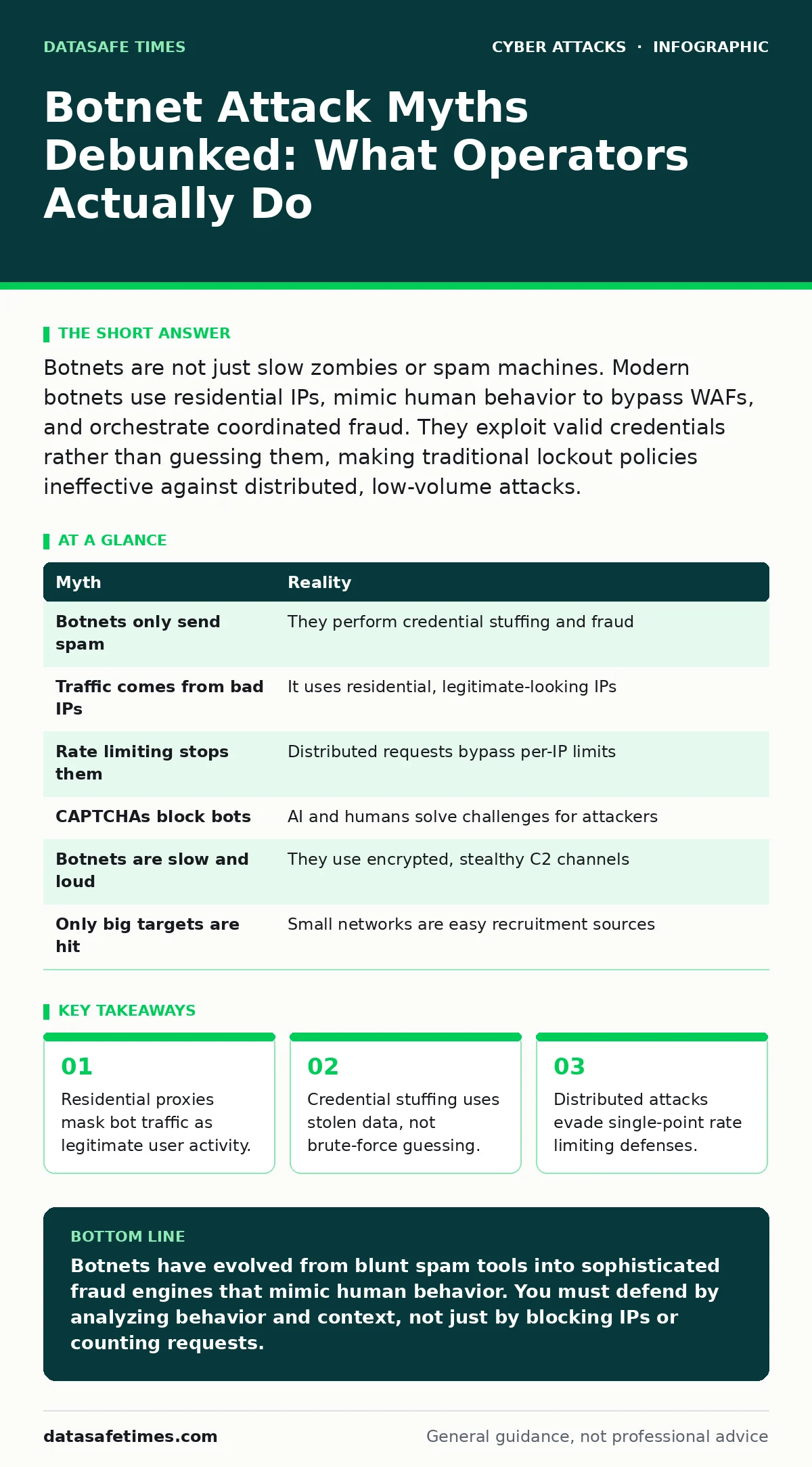
Botnets are not just slow zombies or spam machines. Modern botnets use residential IPs, mimic human behavior to bypass WAFs, and orchestrate coordinated fraud. They exploit valid credentials rather than guessing them, making traditional lockout policies ineffective against distributed, low-volume attacks.
Myth: Botnets Only Send Spam Emails
Reality: The days of simple spam distribution as the primary botnet function are largely over. Modern botnets are engineered for direct financial gain and data exfiltration rather than mass marketing. Operators use compromised devices to perform credential stuffing, where they try valid username and password pairs against web services.
This method relies on previously breached data rather than random guessing. By using accounts that already exist, attackers bypass many security checks that would catch brute-force attempts. The goal is to access accounts to make fraudulent purchases or steal personal information. This shifts the threat from annoyance to immediate financial loss for the victim organization.
Myth: Bot Traffic Comes Only from Known Bad IPs
Reality: Sophisticated botnets route traffic through compromised home routers and mobile devices. These are residential IP addresses that look identical to legitimate users. Traditional IP blacklists fail because the source IPs change constantly and belong to innocent individuals whose devices were hijacked.
You cannot block a geographic region or a known data center range without blocking real customers. The attacker rents access to these residential nodes through peer-to-peer networks or malware. This makes the traffic appear organic to web application firewalls. Defending against this requires behavioral analysis rather than IP reputation scoring.
Myth: Rate Limiting Stops Botnet Attacks
Reality: Standard rate limiting assumes an attacker will hammer a single endpoint from a few sources. Botnets distribute requests across thousands of unique IPs to stay under the threshold for each individual source. If you allow five requests per minute per IP, a botnet with ten thousand nodes can perform fifty thousand requests simultaneously.
This distributed nature bypasses simple counters. The attack becomes a low-and-slow trickle from every direction. To mitigate this, you must look at aggregate patterns across sessions or devices. Implementing advanced rate limiting that considers behavioral fingerprints is necessary. See our guide on rate limiting for more on configuring these thresholds.
Myth: CAPTCHAS Are a Reliable Bot Deterrent
Reality: Modern botnets integrate machine learning models that can solve visual and audio CAPTCHAs with high accuracy. They also use human-in-the-loop services where low-wage workers solve puzzles remotely. The delay introduced by this process is often acceptable for attackers who are not in a race condition.
Furthermore, many CAPTCHAs degrade user experience, causing legitimate visitors to abandon forms. Attackers adapt by using headless browsers that render the challenge page. They may also use AI models trained specifically on the CAPTCHA provider’s image sets. Relying on CAPTCHAs as a primary defense creates a false sense of security. You should combine them with other signals like device fingerprinting.
Myth: Botnets Are Slow and Easily Detected
Reality: Command-and-control channels now use legitimate protocols to hide their traffic. Botnets may use DNS queries, HTTPS streams, or even blockchain transactions to receive instructions. This encryption and protocol blending make the traffic indistinguishable from normal web browsing.
Detection requires deep packet inspection or behavioral anomaly detection. Simple signature-based tools miss these encrypted or disguised commands. The bot may remain dormant for weeks, waiting for a specific trigger. This persistence makes the network appear clean during standard audits. You need continuous monitoring of outbound connections for unusual patterns.
See also: Formjacking Explained: How Script Injection Steals Payment Data · Warning Signs of Open Redirect Vulnerabilities You Can Spot
Myth: Botnets Only Target Large Organizations
Reality: Small and medium-sized businesses are frequent targets because they often lack advanced detection tools. Attackers use automated scanners to find vulnerable endpoints across the entire internet. A small company with exposed administrative interfaces is an easy entry point.
The compromise of smaller networks provides the attacker with a foothold and resources. These compromised systems are then added to the botnet. The victim may not realize their device is part of a larger network. This makes every connected device a potential liability. See our guide on formjacking to understand how attackers steal data directly from your pages.
| Myth | Reality |
|---|---|
| Botnets only send spam | They perform credential stuffing and fraud |
| Traffic comes from bad IPs | It uses residential, legitimate-looking IPs |
| Rate limiting stops them | Distributed requests bypass per-IP limits |
| CAPTCHAs block bots | AI and humans solve challenges for attackers |
| Botnets are slow and loud | They use encrypted, stealthy C2 channels |
| Only big targets are hit | Small networks are easy recruitment sources |
Myth: Password Resets Fix Credential Stuffing
Reality: Forcing password resets does not stop attackers who already have valid credentials from breaches. The attacker still possesses the new password if they are monitoring the account or if the breach was recent. The core issue is the reuse of credentials, not the strength of the current password.
You must detect the attempt to log in with compromised credentials. This requires checking login attempts against known breach databases. If a match is found, you should block the attempt and require additional verification. This approach stops the attack before it succeeds. See our guide on session cookie theft to understand how attackers maintain access after login.
Myth: Botnets Are Easy to Disband
Reality: Botnets use decentralized architectures that survive the takedown of individual servers. When one command-and-control server is shut down, the malware switches to backup domains or uses peer-to-peer communication. The botnet fragments rather than dies.
Operators often sell the botnet infrastructure as a service. This creates a market where new operators can buy existing networks. The resilience of these networks comes from their distributed nature. There is no single point of failure. Your defense must focus on your own perimeter and endpoints. See our guide on MFA fatigue attacks to see how bots bombard users with approval requests.
Key takeaways
- Residential proxies mask bot traffic as legitimate user activity.
- Credential stuffing uses stolen data, not brute-force guessing.
- Distributed attacks evade single-point rate limiting defenses.
Botnets have evolved from blunt spam tools into sophisticated fraud engines that mimic human behavior. You must defend by analyzing behavior and context, not just by blocking IPs or counting requests.
Frequently asked questions
How do I know if my server is under a botnet attack?
Look for spikes in 401 or 403 errors from diverse IP ranges. Check for unusually high success rates on login endpoints that differ from normal user patterns.
Can a firewall stop a botnet?
A traditional firewall cannot distinguish bot traffic from user traffic if the bot uses valid protocols and residential IPs. You need a Web Application Firewall with behavioral rules.
Do MFA codes protect against botnets?
MFA helps, but attackers use bots to send many push notifications to fatigue users into accepting one. This is known as MFA fatigue.
What is the difference between a bot and a botnet?
A bot is a single automated script. A botnet is a network of many compromised devices controlled remotely to perform coordinated actions.
How this guide was produced: written by the DataSafe Times editorial team with AI assistance, checked against the public references listed below, and reviewed when the facts change. See our editorial policy or report an error.